
What Is the Meaning of the Jerusalem Cross?
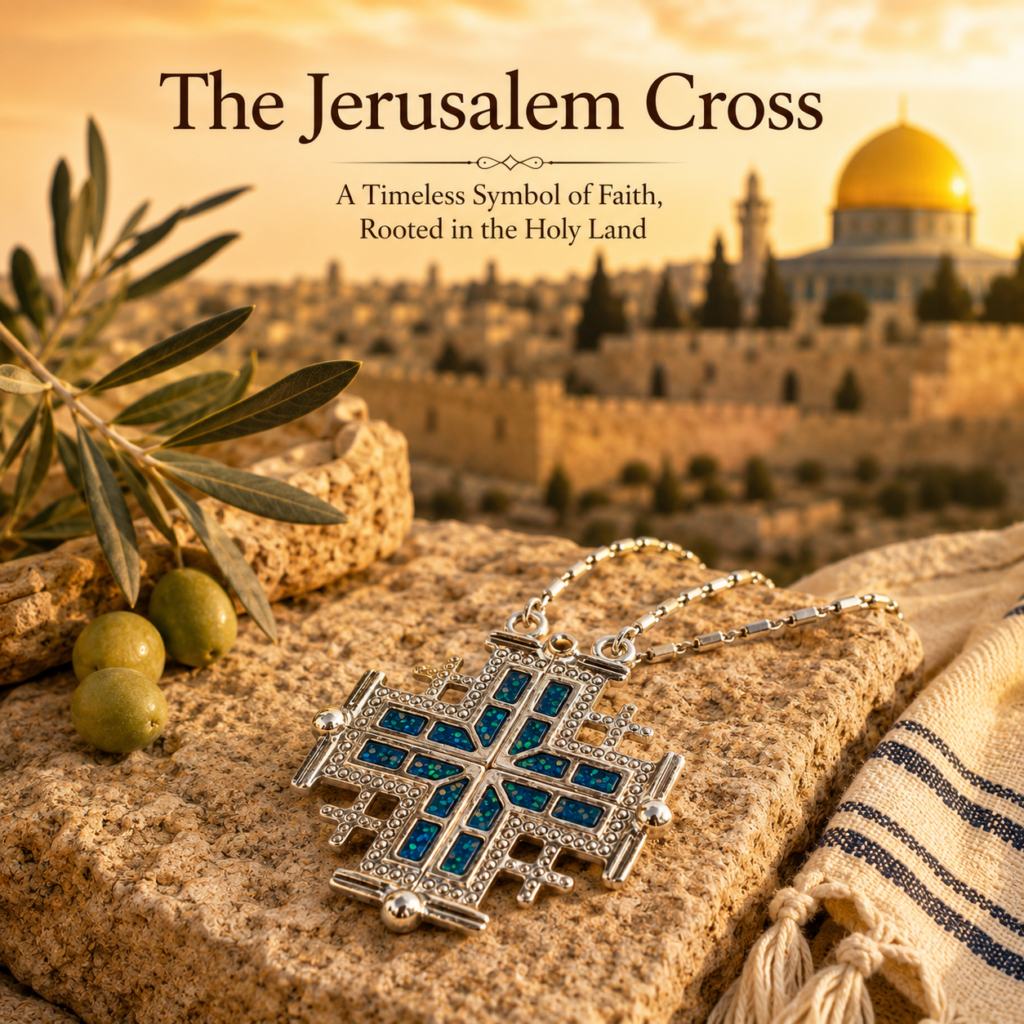
The Jerusalem Cross is one of Christianity’s most recognizable Holy Land symbols. Its design features one large cross at the center surrounded by four smaller crosses. For centuries, it has been associated with Jerusalem, Christian pilgrimage, and the spread of the Gospel.
For many believers today, the Jerusalem Cross is more than a historic emblem. It serves as a reminder of Christ, the message of the Gospel, and Christianity’s deep connection to the Holy Land.
What Does the Jerusalem Cross Look Like?
The traditional Jerusalem Cross consists of five crosses.
A large cross stands at the center. Four smaller crosses appear around it, one in each corner. The central cross is traditionally a cross potent, which has short bars at the ends of its four arms.
This distinctive design has appeared in Christian art, church emblems, religious jewelry, and pilgrimage keepsakes for centuries.
Its five-cross design also allows for several meaningful Christian interpretations.
What Is the Meaning of the Jerusalem Cross?
There is no single interpretation accepted by every Christian tradition. However, several meanings have become strongly associated with the symbol.
One of the most common interpretations sees the large central cross as representing Jesus Christ. The four smaller crosses represent the four Gospels: Matthew, Mark, Luke, and John.
Together, the five crosses can symbolize Christ at the center while His message travels throughout the world.
Another interpretation connects the four smaller crosses with the Gospel reaching the four corners of the earth. This reflects Christ’s command to make disciples among all nations.
Both interpretations emphasize the same central idea: Christ remains at the heart of the Christian faith, while His Gospel is carried outward.
The Jerusalem Cross and the Five Wounds of Christ
Another popular Christian interpretation connects the five crosses with the five wounds of Christ.
In this devotional understanding, the crosses recall the wounds associated with Christ’s crucifixion: His hands, His feet, and His side.
This interpretation can make the Jerusalem Cross especially meaningful during Lent, Holy Week, and Easter.
However, it is best understood as a devotional interpretation rather than the only historical meaning of the symbol.
The History of the Jerusalem Cross
The Jerusalem Cross has a long history.
It became closely associated with the medieval Kingdom of Jerusalem, established following the capture of Jerusalem by Western Christian crusaders in 1099. Because of this history, the symbol is sometimes called the Crusader Cross.
Over time, however, its use extended beyond medieval heraldry.
The Jerusalem Cross became associated with Christian pilgrimage and the Holy Land. Pilgrims visiting Jerusalem often encountered the symbol in churches, religious objects, jewelry, and keepsakes.
Today, many Christians recognize it primarily as a symbol of Jerusalem, Christian faith, and connection to the land of the Bible.
Why Jerusalem Matters to the Symbol
Jerusalem holds an extraordinary place in biblical history.
The city is connected with King David, the Temple, the ministry of Jesus, His crucifixion and resurrection, and the beginnings of the early Christian church.
Because of this sacred history, a symbol carrying the name Jerusalem naturally holds special meaning for many believers.
The Jerusalem Cross can therefore serve as a reminder that Christianity is rooted in real places and events described throughout Scripture.
For believers who love the Holy Land, wearing or displaying the symbol can provide a tangible connection to that biblical heritage.
Why Christians Wear the Jerusalem Cross
Many Christians wear a Jerusalem Cross necklace or pendant as an expression of faith.
For one person, the five crosses may represent Christ and the four Gospels. For another, they may recall the five wounds of Jesus. Someone else may simply see the cross as a reminder of Jerusalem and the Holy Land.
It can also remind believers to keep Christ at the center of their lives while sharing His message with others.
Because of these different layers of meaning, the Jerusalem Cross can be both personal and deeply symbolic.
The Jerusalem Cross as a Christian Gift
The Jerusalem Cross can make a meaningful gift for many faith-filled occasions.
It may be given for a baptism, confirmation, Easter, Christmas, birthday, ministry milestone, or pilgrimage. It can also make a thoughtful gift for pastors, prayer partners, family members, and friends who have a special connection to the Holy Land.
Jerusalem Cross necklaces are particularly popular because they allow the symbol to be worn close to the heart.
Wall crosses and other devotional pieces can also bring its symbolism into a home, church, or prayer space.
A Symbol of Faith and the Holy Land
The meaning of the Jerusalem Cross brings together Christ, the Gospel, and the sacred heritage of Jerusalem.
Its central cross points believers toward Jesus. Its four smaller crosses can remind them of the four Gospels and the call to carry the message of Christ throughout the world.
Other Christians see the five crosses as a reminder of Christ’s wounds and His sacrifice on the cross.
Whatever devotional interpretation speaks most strongly to the believer, the Jerusalem Cross continues to provide a powerful connection between Christian faith and the Holy Land.
Whether worn as jewelry, displayed in a home, or given as a meaningful Christian gift, it can serve as a lasting reminder to keep Christ at the center of life.
Discover our Jerusalem Cross collection at 3 Arches USA and find a meaningful reminder of faith inspired by the Holy Land.
“Bringing a piece of the Holy Land to your home.”

Recent Comments