
Where Is the Ark of the Covenant Today?
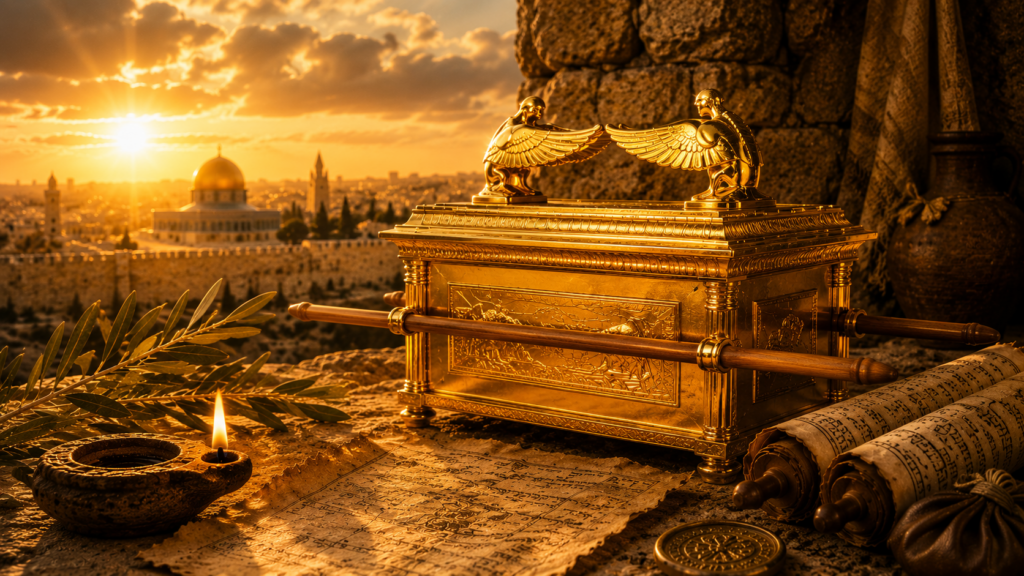
Few biblical objects stir the heart quite like the Ark. For believers, it is not simply a lost treasure. When people ask, Where Is the Ark of the Covenant Today?, they are asking whether one of Scripture’s most sacred signs of God’s presence still exists somewhere on earth.
The Bible presents the Ark of the Covenant as holy and central to Israel’s worship. God commanded Moses to build it in Exodus 25:10–22. The Ark held the stone tablets of the covenant. Hebrews 9:4 also associates it with Aaron’s rod and a golden jar of manna.
Eventually, the Ark stood in the Most Holy Place of Solomon’s Temple. Its importance came not from its gold craftsmanship alone but from what it represented: covenant, holiness, mercy, and the presence of God.
What Happened to the Ark of the Covenant?
Scripture records the Ark inside Solomon’s Temple in Jerusalem. In fact, 2 Chronicles 35:3 mentions the sacred Ark during the reign of King Josiah. After this period, however, its history becomes unclear.
When the Babylonians destroyed Jerusalem and the Temple in 586 BC, biblical accounts describe many Temple treasures. Yet they do not clearly identify the Ark among them.
This silence has led to centuries of debate.
Some people believe priests hid the Ark before the Babylonian invasion. Another theory suggests that the Babylonians destroyed or carried it away. Other religious traditions place it somewhere outside Jerusalem.
However, Scripture does not tell us exactly what happened. Therefore, the disappearance of the Ark remains one of the great mysteries of biblical history.
Where Is the Ark of the Covenant Today?
Several theories attempt to answer this question.
One well-known theory suggests that priests hid the Ark somewhere in or around ancient Jerusalem before the Babylonians captured the city. Some traditions place it in underground chambers near the Temple Mount. However, archaeology has not produced verified evidence that confirms this theory.
Another famous tradition points to Ethiopia. Ethiopian Orthodox tradition maintains that the Ark eventually came to Ethiopia and remains in Aksum at the Church of Our Lady Mary of Zion.
This belief holds deep importance within Ethiopian Christianity. However, independent scholars have not examined the claimed Ark. As a result, historians cannot verify its identity.
Another account appears in 2 Maccabees. It describes the prophet Jeremiah hiding the Ark in a cave before the exile. Some Christian traditions include 2 Maccabees within their biblical canon, while others do not. No archaeological discovery has conclusively identified the location described in this account.
Finally, we must consider a simpler possibility. The Ark may no longer exist. War, conquest, destruction, or the passage of time could have caused its disappearance.
Why No One Knows Where the Ark Is
The clearest answer to Where Is the Ark of the Covenant Today? is that no one currently knows with certainty.
Many fascinating theories and ancient traditions surround the Ark. Nevertheless, historians and archaeologists have not confirmed any discovery as the biblical Ark of the Covenant.
A genuine discovery would require extraordinary evidence. Archaeology, biblical history, religious tradition, and political sensitivities all intersect in this mystery. These factors make serious investigation especially complicated around Jerusalem and its sacred sites.
For believers, separating Scripture from speculation remains important. An exciting theory should not automatically become biblical fact.
Sacred history deserves both reverence and honesty.
What Did the Ark of the Covenant Symbolize?
Beyond its physical construction, the Ark carried profound spiritual meaning.
It represented God’s covenant with Israel and His presence among His people. In addition, the Ark served as a visible reminder of His promises and the holiness of worship.
The atonement cover, traditionally called the Mercy Seat, rested above the Ark. God told Moses that He would meet with him there, above the cover and between the cherubim.
These details connected the Ark with holiness, mercy, covenant, and reconciliation.
Throughout Scripture, the Ark reminds believers that God desires a relationship with His people while remaining holy and worthy of reverence. Therefore, it was never simply an impressive sacred object. It pointed toward deeper spiritual truths within the biblical story.
Why the Ark of the Covenant Still Matters Today
Although its physical location remains unknown, the Ark’s biblical meaning has not disappeared.
The Ark points to God’s holiness and covenant faithfulness. It reminds believers that worship is sacred and that we should approach the presence of God with reverence.
For Christians, the Ark also belongs to the larger biblical story of redemption. The Mercy Seat, atonement, sacrifice, and the Most Holy Place connect with themes that Christians understand in light of Christ and His redemptive work.
Messianic and Hebraic Roots believers may also see the Ark as a powerful connection between the Torah, Temple worship, covenant, and the continuing promises of God.
Because of this enduring symbolism, the Ark continues to fascinate believers thousands of years after it disappeared from the historical record.
The Mystery Behind the Lost Ark
Naturally, the disappearance of the Ark has inspired countless theories.
Could it remain hidden beneath Jerusalem? Perhaps an ancient community carried it somewhere else for protection. The Ethiopian tradition offers another possibility. Alternatively, the Ark may simply have disappeared during the destruction and upheaval surrounding ancient Jerusalem.
Without reliable evidence, we cannot know which explanation is correct.
Still, believers do not need to solve the mystery to appreciate the Ark’s biblical importance. Scripture gives us far greater certainty about what the Ark represented than about what ultimately happened to it.
The Better Question to Ask
Where Is the Ark of the Covenant Today? It is a fascinating question, and we may never receive a definitive historical answer.
Yet believers can ask another important question: What does the Ark teach us today?
First, it teaches reverence and reminds us of God’s holiness.
It also teaches covenant by pointing toward God’s promises and faithfulness.
Most importantly, the Ark reminds us that God continually calls His people to remember Him, honor His Word, and approach Him with reverence.
The mystery of the Ark continues to captivate people around the world. Yet its greatest significance does not depend on where it may be hidden. Instead, its lasting importance comes from what it reveals about the character of God.
Whether the Ark lies beneath ancient stone, rests somewhere yet undiscovered, or has disappeared from history, its witness remains alive in the pages of Scripture.
For those who appreciate the rich biblical heritage of the Holy Land, explore our collection of meaningful religious gifts at 3 Arches USA.
“Bringing a piece of the Holy Land to your home.”

Recent Comments